Introduction
In today’s fast-paced and highly competitive IT landscape, one question continues to challenge both beginners and experienced professionals alike: What matters more, certification or experience? As technology evolves rapidly across domains like cloud computing, cybersecurity, DevOps, and data analytics, employers are constantly searching for candidates who can deliver real value from day one.
On one hand, IT certifications provide structured validation of knowledge and demonstrate a candidate’s commitment to learning. On the other hand, hands-on experience proves the ability to apply skills in real-world scenarios. The debate between certification and experience is not new, but it has become more relevant than ever in a digital-first world driven by continuous innovation.
Understanding how to balance both is critical for career success. This is where VERSAtile Reads helps bridge the gap by offering structured study guides, exam cram notes (ECNs), and practice questions (PQs) that not only prepare learners for certifications but also strengthen practical understanding.
The Growing Demand for Skills in the IT Job Market
The IT job market is evolving rapidly due to digital transformation, automation, and the increasing adoption of advanced technologies. Organizations today require professionals who can not only understand theoretical concepts but also apply them effectively in real-world environments.
With the rise of cloud computing, cybersecurity threats, DevOps automation, and data-driven decision-making, companies are focusing more on skills rather than just academic qualifications. Employers want individuals who can solve problems, adapt to new tools, and contribute to business outcomes.
This shift has created a unique scenario where both certifications and experience play critical roles. Certifications help validate knowledge, while experience demonstrates execution. The challenge for learners is understanding how to balance these two aspects effectively.
What IT Certifications Bring to the Table
IT certifications are designed to validate technical knowledge and align skills with industry standards. They provide a structured pathway for learning and ensure that candidates are familiar with the latest technologies and best practices.
Certifications offer several advantages:
- Structured Learning: Clear roadmap from fundamentals to advanced topics
- Industry Recognition: Globally accepted proof of skills
- Standardized Knowledge: Alignment with current technologies and practices
- Career Entry Point: Ideal for beginners entering the IT field
For example, certifications in cloud computing, cybersecurity, and DevOps help learners understand key concepts such as infrastructure, security controls, automation pipelines, and system design.
However, certifications alone are not enough. They demonstrate what you know, but not necessarily what you can do.
The Value of Real-World Experience
Experience is often considered the ultimate proof of skill. It shows that a professional can apply knowledge in practical scenarios, handle challenges, and deliver results.
Employers value experience because it reflects:
- Problem-solving ability
- Adaptability to real-world environments
- Familiarity with tools and workflows
- Decision-making under pressure
For example, a cybersecurity professional with hands-on experience in threat detection and incident response is often more valuable than someone who has only theoretical knowledge. Similarly, a DevOps engineer who has worked on automation pipelines and deployment processes brings immediate value to an organization.
However, gaining experience can be challenging for beginners, especially those trying to enter the IT industry without prior exposure.
Certification vs Experience: The Real Comparison
The debate between certification and experience is often misunderstood. It is not about choosing one over the other; it is about understanding their roles.
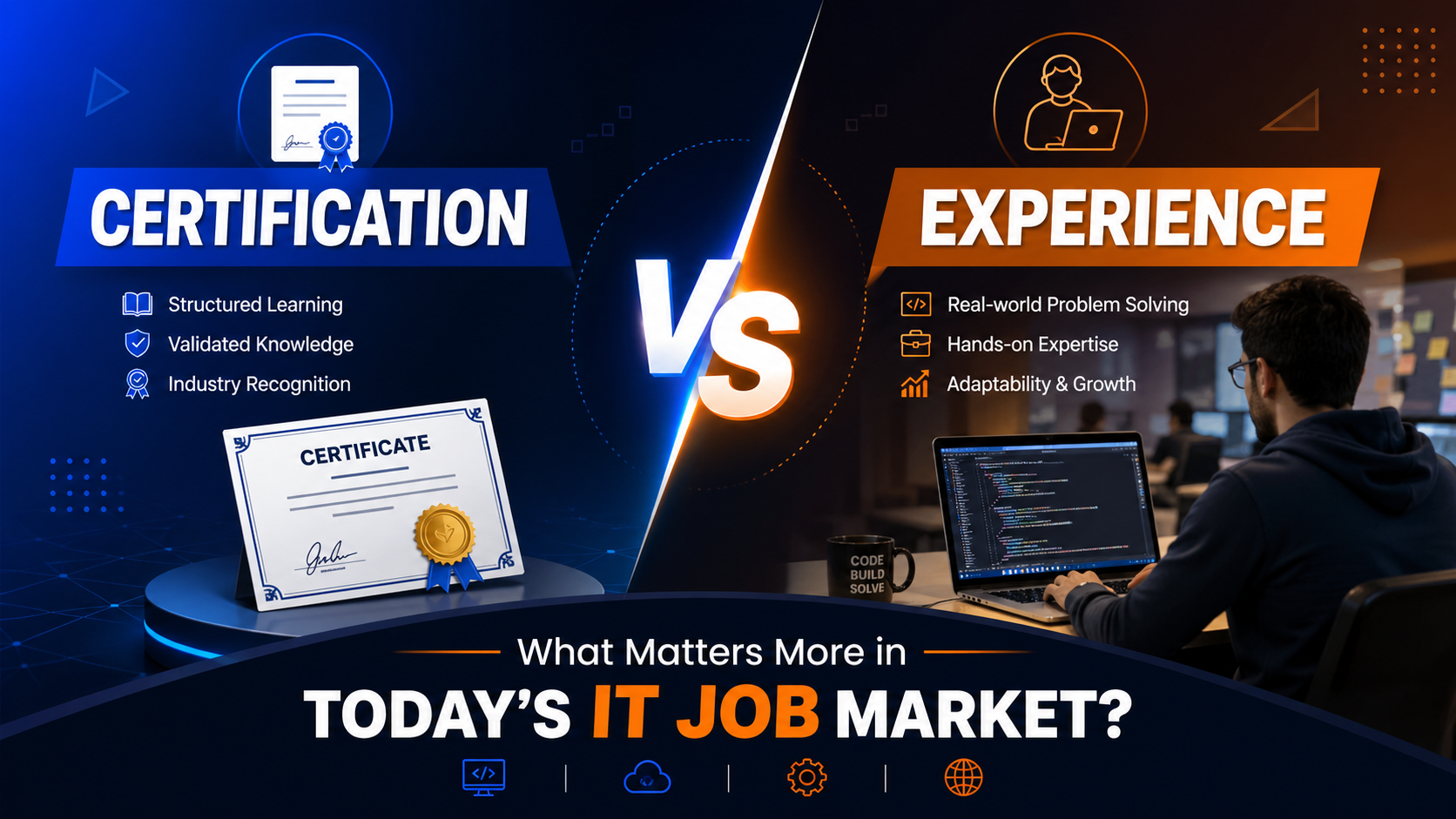
Certifications:
- Validate knowledge
- Provide structured learning
- Help pass HR screening processes
- Build foundational understanding
Experience:
- Demonstrates practical skills
- Builds confidence in real scenarios
- Enhances problem-solving abilities
- Adds credibility during interviews
In reality, certifications and experience complement each other. Certifications help you get noticed, while experience helps you get hired and succeed in the role.
What Employers Actually Look For
Modern employers are shifting toward a skills-first hiring approach. While certifications help candidates stand out, employers are increasingly focusing on practical capabilities.
Key attributes employers look for include:
- Ability to apply knowledge in real-world scenarios
- Understanding of core concepts in cloud computing, cybersecurity, and DevOps
- Problem-solving and analytical thinking
- Hands-on experience with tools and technologies
- Continuous learning mindset
This means that candidates who combine certifications with practical experience have a significant advantage in the job market.
Why Certifications Still Matter More Than Ever
Despite the emphasis on experience, certifications continue to play a critical role in career development. They serve as a starting point for learning and provide credibility, especially for those entering the IT field.
Certifications are particularly valuable because they:
- Help beginners build foundational knowledge
- Provide a structured learning path
- Increase visibility to recruiters
- Validate skills in a standardized manner
In competitive job markets, certifications often act as a filter during the hiring process. They demonstrate commitment, discipline, and the ability to learn new technologies.
The Challenge: Bridging the Gap Between Knowledge and Practice
One of the biggest challenges learners face is bridging the gap between theoretical knowledge and practical application. Many candidates earn certifications but struggle to apply concepts in real-world scenarios.
This gap often leads to:
- Lack of confidence during interviews
- Difficulty solving practical problems
- Limited job opportunities despite certifications
To overcome this challenge, learners need a balanced approach that combines learning with application.
How VERSAtile Reads Bridges Certification and Experience
VERSAtile Reads is designed to solve this exact problem by combining structured learning with practical application.
Exam Cram Notes (ECNs) for Efficient Learning
Exam cram notes focus on high-impact concepts, making it easier for learners to revise quickly and retain important information. They are ideal for busy professionals preparing for certifications.
Practice Questions (PQs) for Real-World Readiness
Practice questions simulate real exam scenarios and practical challenges. They help learners apply their knowledge, identify weak areas, and build confidence.
By combining these resources, VERSAtile Reads ensures that learners not only pass certifications but also develop practical skills that align with real-world requirements.
The Ideal Approach: Certification + Experience
The most effective strategy for career success is not choosing between certification and experience; it is combining both.
A balanced approach includes:
- Building foundational knowledge through certifications
- Reinforcing learning with practice questions and hands-on exercises
- Gaining practical exposure through projects, labs, or internships
- Continuously updating skills to stay relevant
This approach ensures that learners are both knowledgeable and capable, making them highly valuable in the job market.
Career Growth in a Skills-Driven Market
As the IT industry continues to evolve, the importance of skills will only increase. Professionals who invest in both certifications and experience will be better positioned to adapt to new technologies and roles.
Career opportunities in areas such as cloud computing, cybersecurity, DevOps, and data analytics require a combination of theoretical knowledge and practical expertise.
By following a structured learning path and focusing on real-world application, professionals can achieve long-term career growth and stability.
The Future of Hiring: Skills Over Credentials
The future of hiring is moving toward a skills-first model, where practical ability matters more than traditional qualifications. However, certifications will continue to play a supporting role by validating knowledge and providing a foundation for learning.
Organizations are increasingly adopting:
- Skills-based assessments
- Scenario-based interviews
- Practical problem-solving tests
This means that candidates must focus on both learning and application to succeed in the evolving job market.
Conclusion
The debate between certification and experience is not about choosing one over the other; it is about understanding how they work together. Certifications provide the knowledge and structure needed to learn, while experience demonstrates the ability to apply that knowledge effectively.
In today’s IT job market, success comes from balancing both. Professionals who combine certifications with practical skills are better equipped to meet industry demands, secure job opportunities, and achieve long-term career growth.
VERSAtile Reads empowers learners to achieve this balance by offering structured study guides, exam cram notes, and practice questions that bridge the gap between theory and practice.
The smartest approach is not certification or experience, it is certification and experience.
FAQs
Q1. Is certification enough to get a job in IT?
Certifications can help you get shortlisted, but employers also look for practical skills. Combining certifications with hands-on experience significantly improves job prospects.
Q2. How can beginners gain experience without a job?
Beginners can gain experience through labs, projects, internships, and practice questions that simulate real-world scenarios.
Q3. How does VERSAtile Reads help balance certification and experience?
VERSAtile Reads provides study guides, exam cram notes, and practice questions that help learners build knowledge, apply concepts, and prepare for real-world challenges effectively.